What the narrator says
Canada once had a rule for people from India: arrive by one unbroken voyage. There wasn't one. Canada made sure of it.
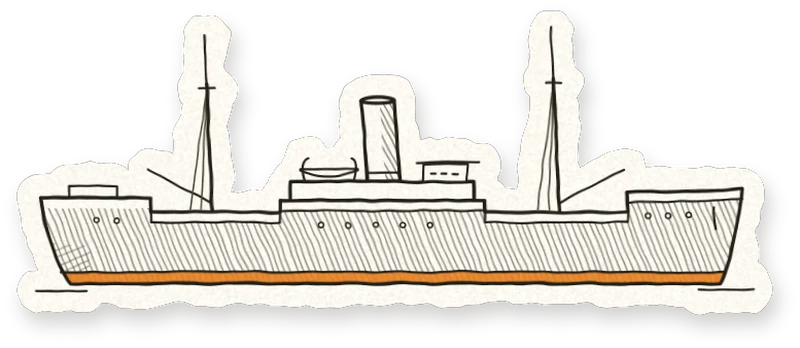
In 1914, Gurdit Singh, a Sikh businessman, hired a ship to test it. The Komagata Maru.
It reached Vancouver with 376 passengers, most of them Sikhs. Canada let only about twenty ashore. The rest were held at anchor for two months. At times they went two days without food or water. When a boarding party came, the passengers drove it off with coal and bricks. Then Canada sent a warship. They were forced back to India. There, police and soldiers fired on them. About twenty were killed.
Gurdit Singh was blamed. He hid for seven years, then gave himself up. He lived to see India free.
In 2012, a memorial was unveiled by the water in Vancouver. In 2016, in the House of Commons, Canada said: we are truly sorry. The rule kept them off that shore. The memorial set their names on it.
In more detail
In 1914 Gurdit Singh, a Sikh businessman, hired a Japanese steamship, the Komagata Maru, to test the rule. It reached Vancouver with 376 passengers, most of them Sikhs from Punjab, and all of them British subjects. Canada let only about twenty ashore, people who had lived in Canada before. The rest were held at anchor for two months, and at times they went two days without food or water. When a boarding party came, the passengers drove it off with coal and bricks. Then Canada sent a warship, the cruiser HMCS Rainbow. On 23 July 1914 the ship was escorted out, and the passengers were forced back to India.
At Budge Budge, near Calcutta, police and soldiers fired on them. About twenty were killed. Gurdit Singh was blamed. He hid for seven years, then gave himself up at Nankana Sahib on 15 November 1921, Guru Nanak’s birth anniversary, and was imprisoned. He lived to see India independent in 1947, and died in Amritsar in 1954.
In 2012 a memorial was unveiled by the water in Vancouver, and the names of the passengers denied entry were set on it. In 2016, in the House of Commons, Prime Minister Justin Trudeau apologised on behalf of the Government of Canada “for the laws that discriminated against you so senselessly”. “For all these things, we are truly sorry.”
Notes and caveats
- “There wasn’t one” means there was no unbroken voyage from India that a passenger could buy. Pier 21 (Canadian Museum of Immigration) says Canadian Pacific had offered a direct service, and that after the 1908 rule the government banned the sale of through tickets. Parks Canada says the government worked with the major steamship companies to end service on these routes. The rule never named Indians, and it also restricted Japanese immigration.
- The ship did not sail from India. It left Hong Kong and called at Shanghai, Moji and Yokohama, the route the map shows.
- The number killed at Budge Budge depends on the source: 19 (the 2016 apology in Hansard), 20 (Parks Canada, The Canadian Encyclopedia), 18 Sikhs killed and 25 wounded (Encyclopaedia of Sikhism), and 22 dead including 16 passengers (Canadian Museum for Human Rights). The film says “about twenty”. Sources disagree on how the shooting began, so the film says only that police and soldiers fired.
- The number let ashore is 20 in Parks Canada; other sources give 22 or 24. The film says “about twenty”.
- Sources give 340 Sikhs, 24 Muslims and 12 Hindus (Canadian Museum for Human Rights, Parks Canada), or “at least 337 Sikhs, about 27 Muslims, about 12 Hindus” (The Canadian Encyclopedia). The film says “most of them Sikhs” and gives no count.
- Accounts of the fight differ on the date (19 or 23 July), the vessel (the harbour tug Sea Lion or HMCS Rainbow) and who tried to board (police, officials or the cruiser’s crew). The film gives no date or vessel for it, and says “Then Canada sent a warship” rather than “So”, because Parks Canada orders the events differently.
- Gurdit Singh was freed after a little more than three months, on 28 February 1922. He was arrested again on 7 March 1922 and held for four years, and was arrested three more times between 1931 and 1933 (Encyclopaedia of Sikhism). The screen says only “imprisoned after surrender”. His birth year differs between sources (1861 or 1877), so the film gives no age.
- The 18 names on screen are passengers refused entry, from the SFU Library passenger list, with its spellings. Each was read on its own record, marked “Deported from Vancouver: Yes”. The list itself says there has never been one definitive passenger list. None of the 18 records says the person was killed. No one in the film is drawn.
What the film leaves out
the court ruling of 6 July 1914, and the Sikh community and friends on shore who sent food and water and hired a lawyer for the passengers. It also leaves out the wounded, and the more than two hundred imprisoned without charge after Budge Budge, with others going into exile (Parks Canada). It does not tell Gurdit Singh’s political work after prison, or the earlier apologies (the British Columbia legislature in May 2008, and Prime Minister Stephen Harper in Surrey in August 2008). It also leaves out the ship’s other name, Guru Nanak Jahaz, and Canada Post’s 2014 stamp. No archive photograph is used: the City of Vancouver Archives photo of the ship could not be fetched at full size.