What the narrator says
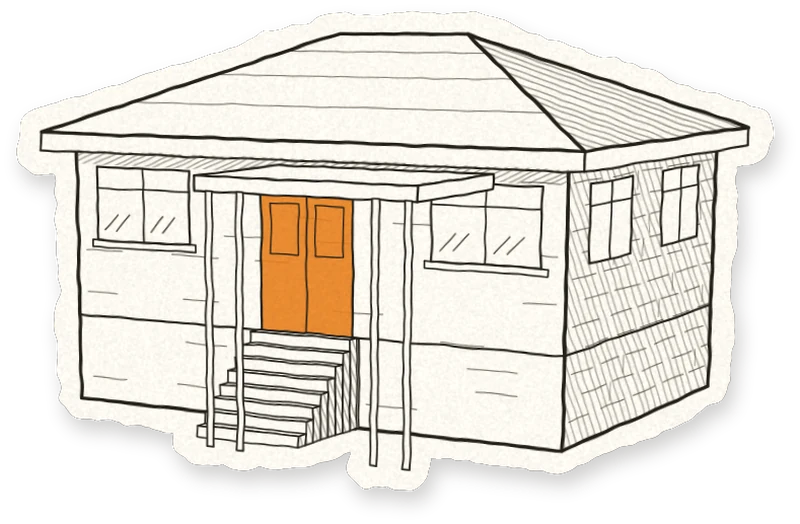
Australia's first gurdwara, a Sikh place of worship, has no dome. Sikh banana growers built it in Woolgoolga: a plain brick hall. One of them, Jagir Singh, bought nine and a half acres in 1951, and lived on them in a tent. Others followed. When they came to build their gurdwara, the growers split. One side wanted a traditional gurdwara, with domes. The other side built theirs Western-style, to welcome Australian guests. Even though the town's clubs wouldn't take Indian members. The night before it opened, in June 1968, someone threw a brick through its window.
The next day, a federal minister opened it. Then the minister took the committee into the bowling club, where no group of Indians had been before.
The traditional side opened theirs in 1970, with domes. In 2019, the hall's own community opened a new gurdwara beside it, with ten domes. Australia's first gurdwara still has no dome. It stands beside ten.
In more detail
The First Sikh Temple, at 6 Hastings Street, Woolgoolga, on the New South Wales north coast, is a plain brick hall built by Sikh banana growers. One of them, Jagir Singh, bought nine and a half acres of bananas in 1951 and lived on them in a tent. Through the 1950s others bought their own farms.
When they came to build a gurdwara in the mid-1960s, the growers split into two committees. One side wanted a traditional gurdwara, with domes. The other built theirs along the lines of a Western place of worship, to welcome its Australian guests. At the time the town’s bowling club and RSL club would not take Indian members.
The night before it opened, in June 1968, someone threw a brick through its window. The next day a federal minister, Senator Reg Wright, Minister for Works, opened it. Then he took the committee into the bowling club. ABC’s Four Corners, filming that day, said it was the first time a group of Indians had ever visited the club. The club still would not take them as members.
The other committee opened its gurdwara on River Street, with domes, on 3 January 1970. In 2019 the First Sikh Temple’s own community opened a new gurdwara beside the hall, with ten domes. The hall was kept, and in 2020 both buildings were listed together on the NSW State Heritage Register (SHR 02044).
Notes and caveats
- “First gurdwara” means the first built as one (the State Heritage Register’s words). Before 1968, Sikhs in the area worshipped in homes and at work.
- Why the community split is not settled. The book the film draws on (Bhatti and Dusenbery, 2001) found “no single overriding reason”. The design was one reason elders gave; others said the differences over design came after the split. The film says only that the sides wanted different buildings, and it judges neither.
- “Western-style, to welcome Australian guests” is that book’s account. Coffs Harbour’s heritage study (2014) also credits the plain design to the late 1960s and the small size of the community then.
- Jagir Singh’s story is his son Piara Singh Sodhi’s, in the same book. A Jagir Singh Sodhi sat on the committee that built the hall, but no source says outright that he is the same man, so the film does not connect them. His name is one ordinary row in the film’s committee list.
- The exact opening day is not confirmed, so the film says June 1968. A 2001 memoir names the minister “Senator Reg Withers”; the 1968 broadcast names “Senator Wright of Tasmania”, and Reg Wright was Minister for Works that year.
- The broadcast says no one seemed to know who threw the brick, and that nearly everybody denied it had anything to do with racial intolerance. The film gives no motive and no culprit.
- The club visit was a visit, not membership: a resolution to admit Indians had been voted down. The film keeps INDIAN MEMBERS: NO on screen after the visit.
- “Ten domes” comes from SBS Punjabi in 2017, while the new building was going up. The film draws ten.
- The roof was concrete tile in the 1967 plans (the film’s title block quotes the building application); it is iron now.
What the film leaves out
the temple’s first granthi was a woman, Surjit Kaur (Narwal). A couple of weeks before the brick, someone had broken in and smashed vases; the broken window was replaced in a hurry before the ceremony. It also leaves out Gurbax Singh Atwal’s opening speech about a bridge between peoples, and the Kipling line the minister is reported to have quoted. It does not cover the barriers beyond the clubs: the dictation test, the rule that wives could join only after the men had lived here continuously, the policy until 1956 of refusing citizenship registration to British subjects of non-European background, and the council’s refusal of a Sikh cremation ground in the 1960s. Nor does it cover what came next: by 2001 Punjabi growers held more than 90 per cent of Woolgoolga’s banana industry, and many families have since moved into blueberries. The River Street gurdwara was rebuilt in 1994. The 2021 census counted 1,059 Sikhs among Woolgoolga’s 6,151 people. No archive photograph is used: none with a reuse licence was found.