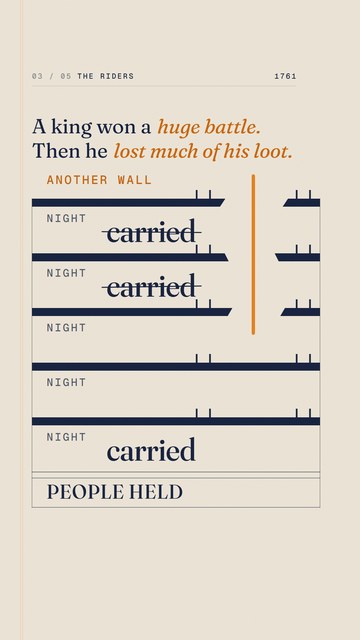
The reel follows Ahmad Shah Abdali's army home in 1761, after a big battle in India: a king who won, and still lost much of his loot to Sikh riders who got past his walls every night. It also carries one reported account of prisoners freed at the Goindwal ferry, marked on screen as a single source.
A king won a huge battle. Then he lost much of his loot. The king was Ahmad Shah Abdali. In seventeen sixty-one, he won a big battle in India. Then he marched home. His army carried stolen goods, or loot, and held people prisoner. The Sikhs followed the army. They rode in small groups. Each night, the king's men built a mud wall. Guards watched the camp. Again and again, the Sikhs got past the guards. They took much of the loot. The next night, the king's men built another wall. The Sikhs came again. One history says the Sikhs freed many women on this march. At Goindwal, boats carried people across a river. One account says the Sikhs freed some prisoners at Goindwal. In that account, the freed prisoners were sent home. The king won the battle. But on the road home, he lost much of his loot. The Sikhs freed many prisoners.
Notes and caveats
Two kinds of line in the film. The first eight cards (the king, the long march home, the nightly walls and the Sikhs getting past them) rest on Khushwant Singh’s history, which describes Sikh bands breaking through the camp night after night, the mud embankments and the chains of sentries, and says they lightened Abdali of much of his spoils. The film says “much”, never “all”: the loot is not shown as gone.
Freed women (card 9). “One history says the Sikhs freed many women on this march” is Singh’s account. The film gives no number, because the source gives none for the march as a whole.
The Goindwal rescue is one account (cards 10 and 11). H. R. Gupta writes that at the ferry of Goindwal on the Beas the Sikhs are said to have relieved the invader of a number of captives, who were afterwards sent to their homes. It is the only source the film uses that places any freeing at Goindwal, and it hedges in its own words. So the film says “One account says”, and on screen the Goindwal ferry is drawn dashed and tagged as a reported account. It is not stated as established fact.
Not two witnesses. Singh’s note on this passage cites Gupta and Ganda Singh, so the two histories are not independent confirmations of each other. The film says “One history” and “One account”, never “two histories agree”.
What the film does not say. No captive count, no leader of the rescue, no council or resolution, no motive, no fighting, and no claim that every prisoner went free: “much”, “many” and “some” only. It does not name the battle or describe who the prisoners were, because the sources it uses for these cards do not support more than “people held”. The only date is 1761; Singh dates the march from March 1761 and Gupta has the Sutlej crossed in early April, so no month is given.
The walls are a visual reading. The second wall on the same night pattern (“the king’s men built another wall”) restates the repeated nightly pattern the sources describe. It is not a second rescue and not a separate event. The words STOLEN GOODS next to the loot gloss “loot”, and the ledger’s labels are the film’s own.
What is drawn. A king’s account book: columns of loot and people held, walls as ruled bands, and a single kesri line passing through them. No person, no face and no Guru is drawn. Goindwal is one point on the Beas and is not shown as where the raids began or ended.
How the sources were read. Both books were read as scanned text. A Sikh history reader or the printed pages should confirm the wording before this is treated as settled.
The wider campaign that followed the battle, the other bands and the other nights, the fate of the freed people, and any account of the march from the Afghan side.
Sources
Khushwant Singh, A History of the Sikhs, vol. 1: 1469-1839 (Oxford University Press), the account of the Sikh attacks on the retreating Durrani army in 1761
H. R. Gupta, History of the Sikhs, vol. 1, Evolution of Sikh Confederacies (the passage on the ferry of Goindwal on the Beas)
Credits
Animation, type and sound made in code, no stock footage or library music.