The reel follows Duleep Singh, proclaimed Maharaja of the Punjab at five, to the treaty of 1849 whose third clause named the Koh-i-Noor, then to the diamond's journey to London and his own return to the Sikh faith at Aden.
At ten, he was a king. At eleven, his diamond was Queen Victoria's.
Duleep Singh was proclaimed Maharaja of the Punjab, a great king, at five. In eighteen forty-nine, after two wars, the British East India Company annexed the Punjab, making it part of its own territory.
The treaty had five clauses. Only one named an object. Clause three: the gem called the Koh-i-Noor "shall be surrendered by the Maharajah of Lahore to the Queen of England." He was ten.
The diamond reached London in eighteen fifty and was presented to the Queen. Today the Koh-i-Noor is in the Tower of London, set in the Queen Mother's crown.
Duleep Singh was baptised a Christian at fourteen, and sailed to England at fifteen. At forty-seven he set out for India. The British stopped him at Aden.
He was never allowed back to the Punjab. At Aden, he returned to the Sikh faith.
Notes and caveats
The clause, in full. Clause III of the Last Treaty of Lahore (29 March 1849), as the treaty prints it: “The gem called the Koh-i-Noor, which was taken from Shah Sooja-ool-moolk by Maharajah Runjeet Singh, shall be surrendered by the Maharajah of Lahore to the Queen of England.” The film speaks and shows the words from “the gem called the Koh-i-Noor” and from “shall be surrendered” to the end, and marks the omitted middle with an ellipsis on screen. Clause II confiscates “all the property of the State” to the Company: it names a class of things, not an object. Clause III is the only one that names a single thing.
“The treaty”, never “he signed”. The treaty’s text says it was accepted for the Maharajah by his Council of Regency, and its signature block lists his name. Harrison writes that “the boy was made to sign” and Atwal that it was “presented to the Maharaja to sign”. The sources differ and the film does not decide it.
Who presented it in 1850. The Royal Collection Trust says only that the Queen “was also presented with” the Koh-i-Noor in 1850. The Express Tribune and Andrews have the East India Company’s chairman and deputy chairman presenting it on 3 July 1850, while Duleep Singh was in India; Historic Royal Palaces says it was “presented to Queen Victoria by Prince Duleep”. The film says “was presented”, in the passive.
The claims. The film says only “its ownership is argued”. What the sources support, and no more: India asked for the diamond’s return in 1947 and Pakistan in 1976 (The Guardian, 14 Oct 2022); Iran is named among the claimants by the BBC (7 Nov 2000); the Taliban government demanded it in 2000 (BBC; Smithsonian); and successive British prime ministers have refused (BBC, 19 Apr 2016). The film gives no number of claimants and does not use “gifted”, “stolen” or “looted”.
Where sources differ. His birth date is given as 4, 6 or 23 September 1838, but every date gives the same ages at the film’s events, so the film uses ages only. The Sikh rites at Aden are dated 25 May 1886 by the Encyclopaedia of Sikhism and SikhNet (one site says 26 May); the film shows “MAY 1886”. The Encyclopaedia of Sikhism says the government “stopped” him and the BBC says he was “detained and placed under house arrest”; the film says “stopped”. No source says he saw the Punjab again, and the Encyclopaedia of Sikhism gives three refusals (1861, 1864, 1886), so the film says “never allowed back”.
“Returned to the Sikh faith”. This is the wording of Historic Royal Palaces and the Royal Collection Trust. The Encyclopaedia of Sikhism says he sought to “rejoin the faith of his forefathers”. The ceremony and those who performed it are not drawn or described.
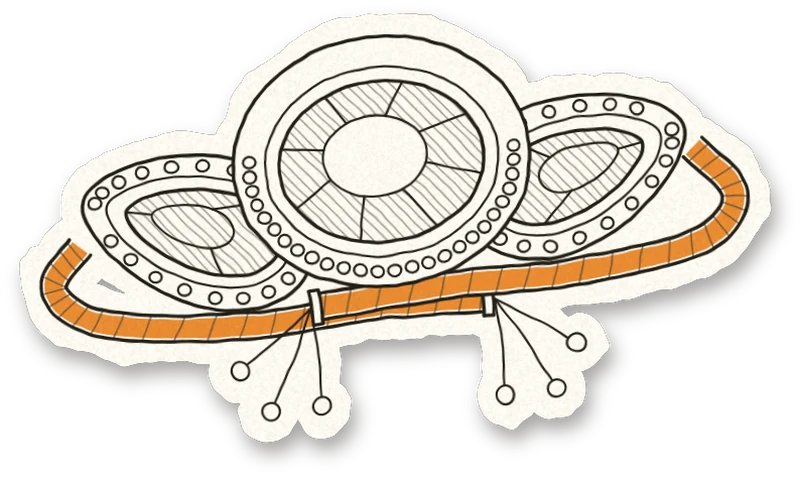
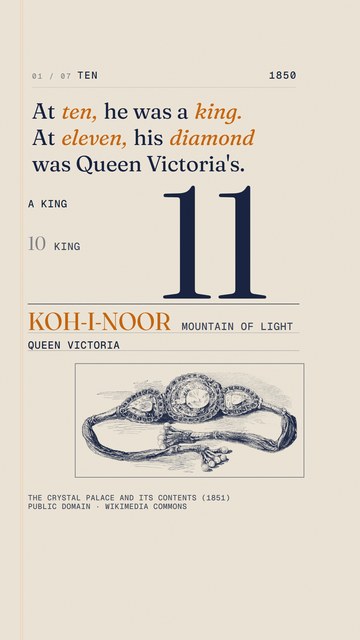
What is drawn, and what is not. No person, hand or figure is drawn, no Guru, no diamond or crown, and no Gurmukhi or Gurbani. The only picture is the 1851 engraving. Everything else is type, rules and one numeral, his age, which rolls up as each thing is done to him.
What the film leaves out
How Ranjit Singh came to have the stone, the re-cut and the Great Exhibition, his death in Paris in 1893 and burial at Elveden, his later campaign, the curse legend, and the owners before Ranjit Singh. No death or burial line was kept, so the film does not end on one.
Sources
Encyclopaedia of Sikhism (Punjabi University, Patiala), "Duleep Singh, Maharaja (1838-1893)"
The Last Treaty of Lahore, 29 March 1849: C. U. Aitchison, A Collection of Treaties, Engagements and Sanads relating to India and neighbouring countries, Vol. I (Punjab), treaty No. XIII, pp. 59 to 60
Priya Atwal, "How Duleep Singh 'handed' it to the Queen", The Tribune (21 Apr 2016)
Arun Kumar, "No ordinary diamond", The Conversation (1 Mar 2023)
Mary-Catherine Harrison, "The Koh-i-Noor Diamond and Dinah Mulock Craik's Fantasy of Consensual Colonization", Nineteenth-Century Gender Studies 20.2
Iradj Amini, "Koh-i-Noor", Encyclopaedia Iranica
J. G. A. Baird (ed.), Private Letters of the Marquess of Dalhousie (Blackwood, 1910)
Historic Royal Palaces, "The Crown Jewels Up Close", "Duleep Singh" and "Symbols of power: chronology"
Royal Collection Trust, "Diamonds in the Royal Collection", RCIN 31703, and "Maharaja Duleep Singh"
BBC News, "Koh-i-Noor: India says it should not claim priceless diamond from UK" (19 Apr 2016), "Taleban demand gem from UK crown jewels" (7 Nov 2000) and "Should the last Sikh maharajah be returned to India?" (3 Jul 2014)
Lorraine Boissoneault, Smithsonian Magazine (30 Aug 2017)
William Dalrymple, Scroll.in (20 Dec 2016)
Athar Ahmed Saeed, The Express Tribune (21 May 2016)
Angela Magnotti Andrews, jewelry-history.com
Jasbir Singh Sarna, SikhNet (27 Sep 2022)
Sikhitihas, "Maharani Jind Kaur imprisoned and exiled"
The Guardian, Anita Anand (14 Oct 2022)
Wallace Collection, "Duleep Singh Family"
Credits
Engraving: "The Koh-i-Noor, or Mountain of Light, in its original setting", wood engraving from The Crystal Palace and its Contents: being an illustrated cyclopaedia of the Great Exhibition of the Industry of all Nations, 1851 (London, 1851). Public domain, via Wikimedia Commons (File:Kohinoor.jpg). Cropped and toned to the film's paper.
Animation, type and sound made in code, no stock footage or library music. The sounds are a tanpura-style drone and a few soft synthesised notes and ticks.