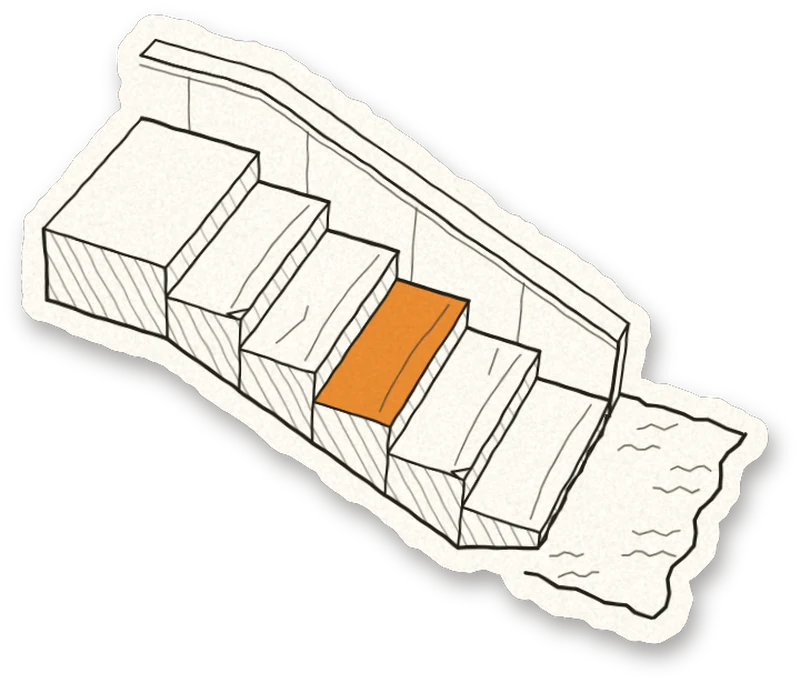
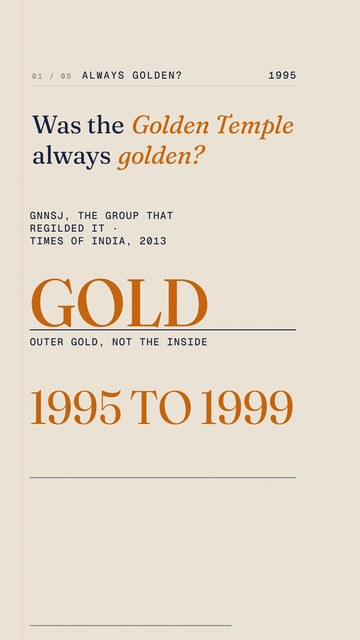
The reel asks whether the Golden Temple was always golden. It follows the outer gold laid again in 1995 to 1999, the walls rebuilt after 1762, and the first Harmandir Sahib of 1604, set lower than the ground around it so that everyone steps down to enter.
Was the Golden Temple always golden? Its outer gold was laid again in the nineteen nineties. What came before? No. The first gold went on under Maharaja Ranjit Singh, Punjab's ruler, in the early eighteen hundreds.
The walls beneath it are not the first, either. In 1762 an Afghan invader blew them up with gunpowder. Sikhs rebuilt them.
In 1604, Guru Arjan Dev Ji, the fifth Sikh Guru, finished the first Harmandir Sahib: the House of God. He set it lower than the ground around it, so everyone steps down to enter, and gave it a door on every side. The usual reading: humility, and a welcome to all.
Ranjit Singh's gold changed the rebuilt shrine's look, not its basic design, says the Encyclopaedia of Sikhism. Walls rebuilt, gold laid again, and you still step down to it.
The gold came later. The way down came first.
Notes and caveats
What is record and what is interpretation. Everything the film says as fact is record: the 1995 to 1999 regilding (the Guru Nanak Nishkam Sewak Jatha, the group that did it, and the Times of India and the Tribune), the first gilding under Ranjit Singh (Britannica, the Encyclopaedia of Sikhism, the Tribune), the 1762 blowing up with gunpowder and the rebuilding begun in 1764 and done by 1776 (the Encyclopaedia of Sikhism, the SGPC), and Guru Arjan Dev Ji finishing the first Harmandir Sahib in 1604. The one interpretation is what the lower level and the four doors mean: the film calls it “the usual reading”. Britannica says the Guru “symbolically” placed it lower so that “even the humblest had to step down to enter”, and that the four entrances signify openness to “worshippers of all castes and creeds”. No quotation is put in the Guru’s mouth.
What the film claims, and does not. It claims a design principle: Britannica ties a lower approach and an entrance on every side to the first design of 1604, and the Encyclopaedia of Sikhism, the SGPC and India’s UNESCO tentative-list text describe the same two features later. It does not claim that any 1604 stair stone or the whole 1604 plan survived 1762, and it does not claim that older gilding lies under the modern gilding.
The Encyclopaedia of Sikhism qualifier. “Basic design” is the encyclopaedia’s word, and its sentence reads: “While its basic design barring minor alterations and architectural embellishments remained the same as before”. The comparison is Ranjit Singh’s work against the shrine rebuilt by 1776, so the film never sets it against 1604. This rests on one source, a good one.
“Step down to it”. The 2004 UNESCO tentative-list text, a submission by the Government of India and not a listing, says the gateways are at a higher level than the core precinct and have “a descending flight of steps” inside. The film says “you still step down to it”, not that the shrine is below ground.
Where sources differ. On 1757 and 1762: some say the shrine was destroyed in 1757 and again in 1762. The Encyclopaedia of Sikhism calls 1757 a desecration and 1762 the blowing up, and Britannica says “destroyed several times”, so the film says only 1762. On the finishing year: the SGPC prints “1601 A.D.” beside Bikrami 1661, which is 1604, and the Encyclopaedia of Sikhism and Britannica say 1604; start dates differ, so the film says “finished”, not “founded”. On “early 1800s”: the first gold spans about 1802 to 1830, so the film never gives a single year. On the four doors: some modern accounts read them as the four traditional castes, while Britannica and the Encyclopaedia of Sikhism say openness to all, and the film says only “a welcome to all”.
Outer, not inner. “Outer gold” is deliberate: the interior gilding and fresco restoration began in 2022 and is still under way, by the group’s own project list.
What is drawn, and what is not. No person, hand or figure, and no Guru. The shrine itself is never drawn or animated: its one appearance is Beato’s photograph, labelled on screen and credited, with no people in it (two tiny seated figures in the original were cropped out). No Gurmukhi or Gurbani is used.
What the film leaves out
Who laid the foundation stone, the later retellings that put sayings in the Guru’s voice, the 1757 defence and any count of the dead, 1984, the 1990s argument about conservation methods, the amount of gold, the interior regilding from 2022, and the marble.
Sources
Encyclopaedia of Sikhism (Punjabi University, Patiala), "Harimandar", "Amritsar" and "Des Raj, Bhai"
Britannica, "Golden Temple" (revised by Charles Preston)
Guru Nanak Nishkam Sewak Jatha, "External gold gilding begins Sri Harmandir Sahib, Amritsar", 3 Feb 1995, and the Panthic Kar Sewa project list (gnnsj.org)
The Tribune, Saturday Plus, 17 Apr 1999
The Times of India, Yudhvir Rana, 31 May 2013
Hindu Vivek Kendra news item, 21 Jul 1997 (hvk.org)
UNESCO World Heritage Centre, Tentative List ref. 1858, "Sri Harimandir Sahib, Amritsar, Punjab" (submitted by the Government of India, 5 Jan 2004)
S. S. Bhatti, "Golden Temple" (PhD text, read as an excerpt)
Wikimedia Commons, Felice Beato, "The Golden Temple at Amritsar" (Google Art Project copy of the J. Paul Getty Museum print)
Credits
Photo: Felice Beato, The Golden Temple at Amritsar, 1858 to 1859, albumen silver print, J. Paul Getty Museum. Public domain (the photographer died in 1909), via Wikimedia Commons. Cropped to the shrine and toned to the film's paper.
Animation, type and sound made in code, no stock footage or library music. The sounds are synthesised.