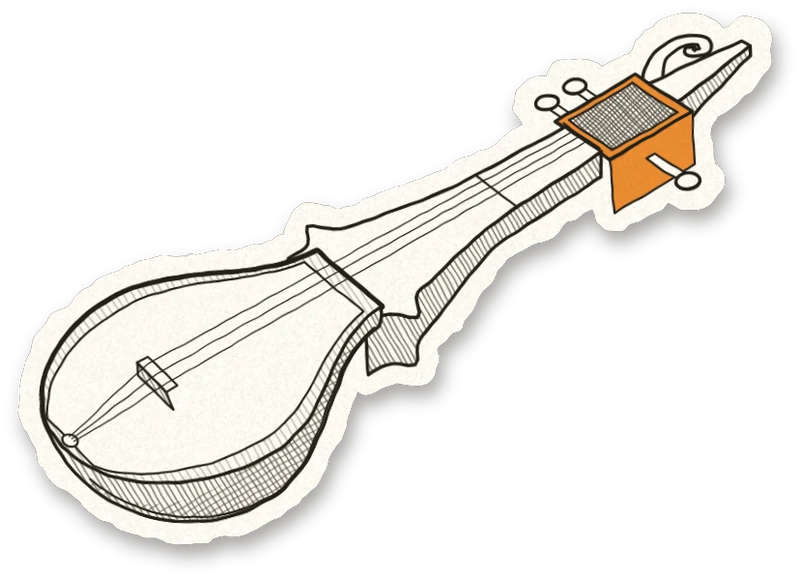
The reel follows Bhai Mardana, the rabab player who travelled with Guru Nanak Dev Ji, to the Muslim rababi families who sang Sikh hymns at the Golden Temple until 1947. It closes on a word that stayed: Bhai, brother.
Muslim musicians sang Sikh hymns at the Golden Temple, until 1947. It began with one man, and a rabab: a plucked lute. Bhai Mardana: from a Muslim family of musicians, in the same village as Guru Nanak Dev Ji, the first Sikh Guru. When the Guru set out on his journeys, Bhai Mardana went too, and never left his side. The old life stories keep repeating one line: Mardana, play the rabab. He played. The Guru sang.
In the Sikh scripture, his name heads three verses. Scholars differ on who wrote them.
After him, rababis, Muslim rabab players, sang for the Gurus, then at the Golden Temple. Then, in 1947, a border split Punjab, and rababi families left Amritsar for Lahore. Many had to find other work, and other music.
But one word stayed. The musicians who sing at the Golden Temple today are still called Bhai, as he was. Bhai means brother.
Notes and caveats
What is tradition and what is record. The companionship and the rabab are in the earliest Sikh writing outside scripture, the Vaaran of Bhai Gurdas: Var 1.35 calls him the rababi beside the Guru (ਇਕੁ ਬਾਬਾ ਅਕਾਲ ਰੂਪੁ ਦੂਜਾ ਰਬਾਬੀ ਮਰਦਾਨਾ।) and Var 11.13 lists “Mardana the Mirasi” among Guru Nanak’s Sikhs. The line “Mardana, play the rabab.” and the scenes around it are the janamsakhis’, the life stories of Guru Nanak first written down probably in the late sixteenth century. The words are W. H. McLeod’s translation of the B40 janamsakhi (compiled 1733), where the request recurs at least nine times. The often-quoted “the Word is descending” is not in that text, so the film does not use it.
The three verses. On Ang 553 of Sri Guru Granth Sahib, in Raag Bihagra, two headings carry his name: ਸਲੋਕੁ ਮਰਦਾਨਾ ੧ ॥ (BaniDB line 24320) over the first shalok and ਮਰਦਾਨਾ ੧ ॥ (line 24327) over the second and third. The Encyclopaedia of Sikhism reads one shalok (the third, on the company of the holy, which has no “Nanak” in it) as Bhai Mardana’s and two as Guru Nanak’s, addressed to him. Prof. Sahib Singh’s Darpan reads all three as Guru Nanak’s, addressed to Mardana, because Bhai Mardana would not have used the name “Nanak”. The film shows both readings with their sources and calls neither right. The Gurmukhi on screen is copied from BaniDB (the database SikhiToTheMax reads) and rendered as whole shaped lines.
His faith. Sources describe it differently: the Encyclopaedia of Sikhism calls him Guru Nanak’s “long-time Muslim companion”, and Bhai Gurdas lists him among the Guru’s Sikhs. The film says only “from a Muslim family of musicians”, which every source supports.
No dates, no count of years. The Encyclopaedia of Sikhism gives 1459 to 1534 and death at Kartarpur; other references give other dates and places. It gives no number of years together, so the film says “never left his side”, not “forty years”.
The rababis before 1947. The rababis’ place at the Darbar Sahib narrowed from the 1920s, before Partition: some were removed from duty in those years. Some of the best-known rababis still performed at gurdwaras until 1947, when the Amritsar community migrated to Lahore (Kirit James Singh, SOAS PhD thesis, 2023, pp. 199-210 and 214-219). Not every rababi family left: some stayed and became Sikhs, which is why the film says “rababi families”, not “the rababis”.
After 1947. Reports record that the SGPC declined Bhai Ghulam Muhammad Chand’s request to perform at Harmandir Sahib, citing that he was not an initiated Sikh. Accounts differ on the date. The Rehat Maryada’s general provision states that only a Sikh may perform congregational kirtan. (The report: The Tribune, 12 July 2015, and TAROSA. The provision: Sikh Rehat Maryada, Article VI(a), “Only a Sikh may perform Kirtan in a congregation.”)
“One word stayed.” The close claims only that the title Bhai is used for the musicians at the Golden Temple today, as it was for him: every ragi on the SGPC’s kirtan duty list for Sachkhand Sri Harmandir Sahib, 18 to 30 October 2026, is listed as Bhai. It does not say that rababis returned or that nothing changed. The Encyclopaedia of Sikhism: Bhai “means brother in its literal sense”, and gurdwara musicians are “commonly designated Bhāī”.
What is drawn, and what is not. No person, hand or figure is drawn, and no Guru. The instrument is only six strings, pegs and a bridge: six because Abu al-Fazl, Akbar’s chronicler, wrote that the rabab “normally had six strings” (cited by McLeod). No body is drawn, because the form of Bhai Mardana’s own rabab is not documented in a surviving instrument. The photograph is a later rabab in the Met (north India, about 1885), labelled on screen as such; it is not his. The sounds are synthesised plucked strings tuned to the drone, not a rabab recording; no licensed recording of a plucked rabab was found.
What the film leaves out
His death and its place, the 1947 killings, Bhai Ghulam Muhammad Chand’s return visit to Punjab in 2004 or 2005, and the 2022 directive to bring string instruments back to the Golden Temple.
Sources
Encyclopaedia of Sikhism (Punjabi University, Patiala), "Mardānā, Bhāī", "Bhāī" (W. H. McLeod), "Balvaṇḍ, Rāi", "Sattā" and "Rāmkalī kī Vār"
BaniDB / SikhiToTheMax, Sri Guru Granth Sahib Ang 553 (lines 24320, 24327) and Ang 966 (line 41341), Vaaran Bhai Gurdas 1.35 and 11.13
Prof. Sahib Singh, Sri Guru Granth Darpan, p. 553
W. H. McLeod, The B40 Janam-Sakhi (Guru Nanak Dev University, 1980) and Textual Sources for the Study of Sikhism (Manchester University Press, 1984)
Navtej K. Purewal, "Sikh/Muslim Bhai-Bhai?", Sikh Formations 7:3 (2011)
Kirit James Singh, Sikh Patronage of Hindustani Music and Sabad Kirtan in Colonial Punjab, 1857-1947 (SOAS PhD thesis, 2023)
The Tribune, "Stringing the perfect sound for 'kirtan'" (12 Jul 2015)
TAROSA, "The Life of a Rababi: Bhai Ghulam Muhammad Chand" (2015)
Dawn, Haroon Khalid (20 Apr 2018)
ThePrint, "Rababi Muslims sang keertans in Golden Temple" (10 Feb 2025)
LBF Virtual Museum, "Bhai Chand"
SGPC, kirtan duty list, Sachkhand Sri Harmandir Sahib, 18 to 30 Oct 2026
Photo: Rabab, north India, ca. 1885. The Metropolitan Museum of Art, The Crosby Brown Collection of Musical Instruments, 1889 (89.4.170). Public domain (https://www.metmuseum.org/art/collection/search/500716). Rotated, cropped and toned to the film's paper.
Animation, type and sound made in code, no stock footage or library music. The plucked strings are synthesised.