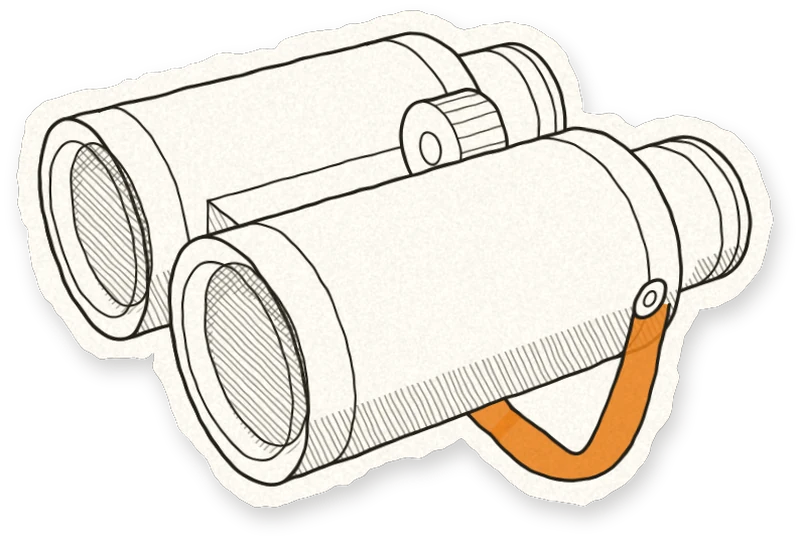
The reel asks why Sikhs look at the shrine at Kartarpur through binoculars. It follows the viewing platform at the border, the corridor that opened in 2019 and closed in May 2025, and says plainly that it was still closed when the reel was made in October 2026.
Why do Sikhs look at this shrine through binoculars? It's at Kartarpur, where Guru Nanak Dev Ji, founder of the Sikh faith, spent his last years. It's about four kilometres away.
Then Partition put a border between here and there. Getting there took a visa, and a long way round. So a charity built a platform at the edge. Border guards brought binoculars. People folded their hands and bowed, four kilometres away. Sikhs call it darshan: seeing the sacred. Their daily prayer asks for more. Khulle darshan. Open darshan.
The platform was knocked down, to build a road. In 2019, it opened. No visa. A passport, and home by dusk. Four kilometres. You could walk it. Over 400,000 pilgrims crossed.
In 2025, in a crisis between the two countries, it closed. As we make this, it's still closed. So people are back at the edge, looking. Binoculars give them darshan. The prayer still asks for the open kind.
Notes and caveats
Binoculars, not only binoculars. The shrine can be seen with the naked eye on a clear day, and pilgrims with visas could reach it before 2019, through Lahore. The film asks why Sikhs look through binoculars, not why they could only look. Most reports say binoculars; some say a telescope or both. The 2008 platform had BSF binoculars; the viewing point refurbished in January 2024 has two high-range binoculars.
“About four kilometres.” Reports give 4, 4.5 and 4.7 km, depending on whether they measure from the platform, the border or the town, by road or in a straight line.
Who built the platform. Most accounts credit the Baba Gurcharan Singh Bedi Baba Jagdeep Singh Bedi Memorial Charitable Hospital; one 2008 headline says the BSF built it. Read whole, the charity paid for and built it, and the BSF permitted it and supplied the binoculars. It was about 3.5 m high and opened in May 2008 (the 6th or the 8th, by source). Before it, devotees sat on the Ravi’s flood embankment to look.
“His last years.” Sources give 17 or 18 years at Kartarpur, and several founding dates, so the film says only “his last years”.
The Ardas. The line is from the Ardas as given in the Sikh Rehat Maryada (SGPC), Article IV 3(a): ਖੁਲ੍ਹੇ ਦਰਸ਼ਨ ਦੀਦਾਰ ਤੇ ਸੇਵਾ ਸੰਭਾਲ ਦਾ ਦਾਨ ਖ਼ਾਲਸਾ ਜੀ ਨੂੰ ਬਖਸ਼ੋ. SGPC’s English renders it as a prayer for “unobstructed visit to and free management of Nankana Sahib … and other shrines … from which the Panth has been separated”. The Gurmukhi on screen (ਖੁਲ੍ਹੇ ਦਰਸ਼ਨ) is copied from SikhiToTheMax’s copy of that text and checked against SGPC’s PDF. It is Ardas, not Gurbani. Sources link the line to Partition, but none read here dates when it was added, so the film does not date it.
The road and the walk. The platform was dismantled in 2019 to make way for the corridor project. The 2019 agreement allowed pilgrims to cross on foot; a shuttle also ran, so the film says “you could walk it”, not that everyone did.
The count. Over 400,000 pilgrims crossed between November 2019 and May 2025, by the government’s answer in the Rajya Sabha (31 July 2025) and the Land Ports Authority’s yearly figures. The corridor also closed for the pandemic (March 2020 to November 2021).
The closure. The government told the Lok Sabha on 31 July 2026 that services were suspended with effect from 7 May 2025, and reports in September and October 2026 say it remains closed. The film names no government and gives no reasons; it says only that it closed in a crisis between the two countries. Access to the viewing point was also halted for a time in May 2025; when it resumed was not found. By September and October 2026 it was in daily use again.
What the film leaves out
No person is drawn: the film is type, ruled lines, two circles for the binoculars, a land-only locator map (no borders drawn on it) and one photograph of the building, cropped above its signboards and with no people in it. The pilgrim fee, the trees and grass reportedly cleared on the far side to keep the view open, a telescope tower planned in 2022 (not confirmed built) and the 2026 disputes over prayers at the border are left out.
Sources
The Tribune, "Platform for Kartarpur shrine view is history" (8 May 2019), "BSF constructs viewing area" (25 Apr 2008), "Kartarpur Corridor to remain closed amid security concerns, says MHA" (23 Sep 2026) and "Explainer: Emotional saga of the open-shut Kartarpur Corridor" (26 Sep 2026)
Times of India, "Kartarpur corridor: Darshan Sthal at border to be dismantled" (27 Apr 2019) and "NGO offers to install binoculars at Darshan Sthal" (8 Jan 2023)
Hindustan Times, "Darshan asthan facelift in Dera Baba Nanak" (31 Jan 2024)
BBC News, "Kartarpur corridor: India pilgrims in historic visit to Pakistan temple" (9 Nov 2019)
PIB, "India signs the Kartarpur Sahib Corridor Agreement with Pakistan" (24 Oct 2019)
Lok Sabha unstarred question 2262 (31 Jul 2026)
Rajya Sabha answer reported by PTI (31 Jul 2025)
Land Ports Authority of India, PTB Dera Baba Nanak
Indian Express, "Kartarpur Corridor closed for pilgrims" (7 May 2025)
Dainik Jagran (21 Sep 2026) and Punjabi Jagran (11 Oct 2026)
Sikh Rehat Maryada (SGPC), Article IV, via SikhiToTheMax
Tejpaul Singh Bainiwal, "Religious and Political Dimensions of the Kartarpur Corridor", Religions 11(11):560 (2020)