The Sikh Empire
1799–1849
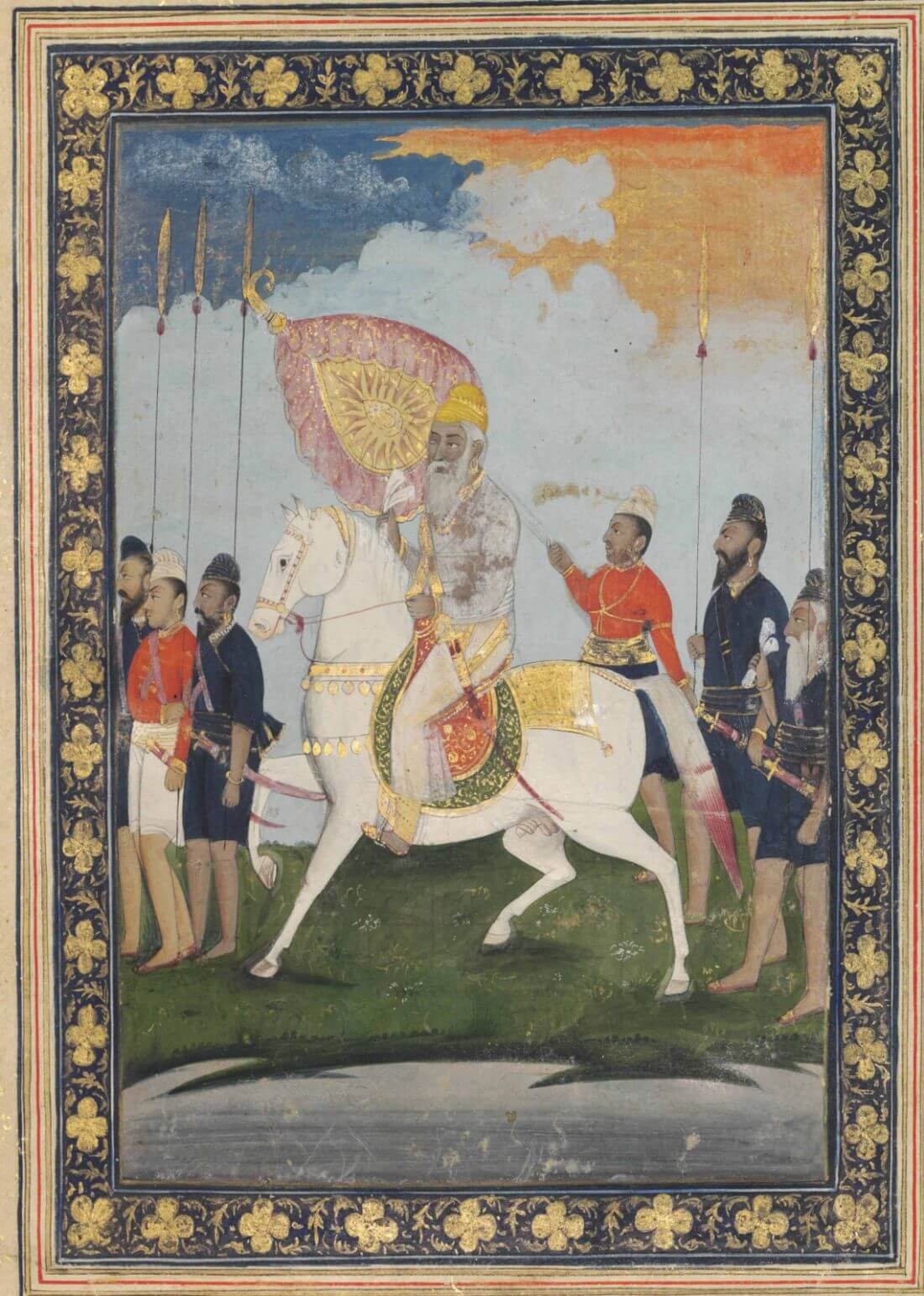
Maharaja Ranjit Singh unified the misls into a powerful, secular kingdom centred on Lahore, ruling from 1799 until his death in 1839. After two Anglo-Sikh wars the empire fell to British annexation in 1849.
A kingdom at Lahore
In 1799 Ranjit Singh, sardar of the Sukerchakia misl, seized Lahore and made it his capital. On Vaisakhi — 12 April 1801 — he was proclaimed Maharaja, crowned by Sahib Singh Bedi, a descendant of Guru Nanak.1,2,4
A secular state
His kingdom was notably secular for its age: Hindus, Muslims and Sikhs alike served in its administration and in its modernised army, parts of which were trained by European officers. At its height the empire reached from the Khyber Pass to Kashmir. Ranjit Singh died in 1839.1,4
The empire falls
Without him the empire fractured. Two Anglo-Sikh Wars followed — the first in 1845–46, the second in 1848–49 — and after the British victory at Gujrat the Punjab was annexed on 29 March 1849, and the boy Maharaja Duleep Singh deposed.1,3,4
In this chapter
- Ranjit Singh Captures Lahore1799
- Ranjit Singh Proclaimed Maharaja1801
- Treaty of Amritsar1809
- The Conquest of Multan1818
- The Battle of Jamrud1837
- The Death of Ranjit Singh1839
- The First Anglo-Sikh War1845
Last updated: